
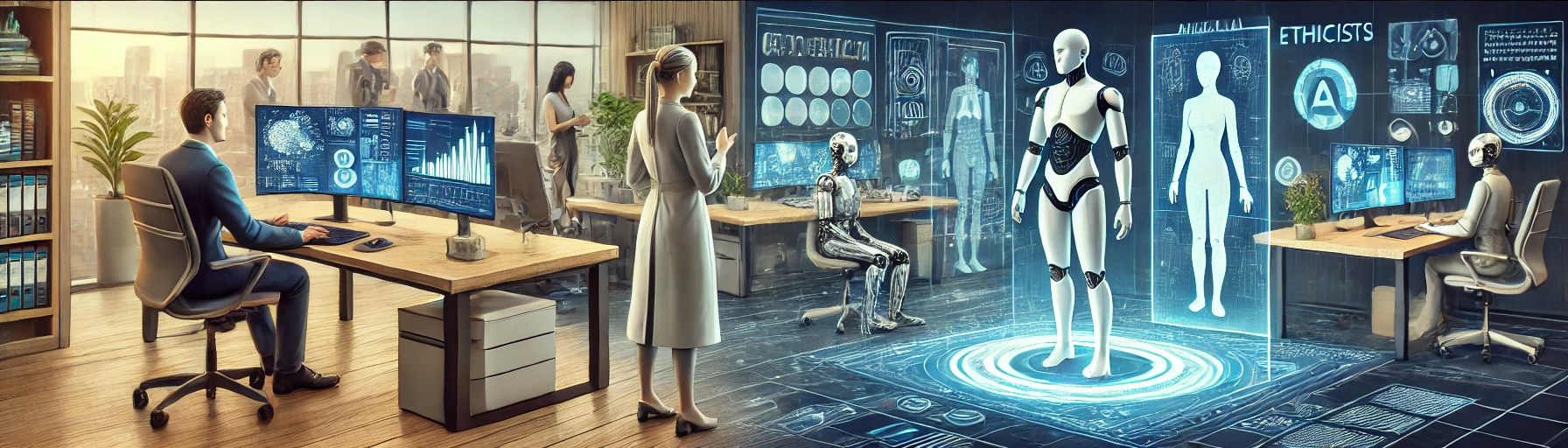
Artificial Intelligence is stepping into a revolutionary phase where agents are no longer just advisors—they are becoming active participants in executing tasks. During his CES 2025 keynote, NVIDIA CEO Jensen Huang introduced the core concept of “Agentic AI”: systems that can perceive, reason, plan, and act autonomously.
This evolution marks a profound shift in how we work, live, and innovate, moving beyond simple chatbots to proactive digital entities.
🛠️ IT Departments as Digital HR 💼
One of the most provocative ideas from Huang’s vision is the transformation of the IT department. He envisions a future where IT functions as the HR department for a digital workforce.
Instead of managing just hardware and software, IT teams will:
- Onboard and Train: Deploying fleets of AI agents tailored to specific business logic.
- Maintain Performance: Monitoring the "productivity" and "behavior" of digital employees.
- Orchestrate Workforces: Managing a hybrid environment where biological and digital employees collaborate seamlessly.
🤖 AI Agents as Digital Teams 👥
The power of Agentic AI lies in collaboration. Rather than a single tool, imagine a "swarm" or network of agents working tirelessly. These teams are already making an impact across several domains:
- Customer Service: Moving from static FAQs to agents with natural voice capabilities that can resolve complex billing or technical issues autonomously.
- Recruitment: Automating the end-to-end process of candidate sourcing, initial engagement, and interview scheduling.
- Physical AI: Platforms like NVIDIA Cosmos are enabling robots to perceive and act dynamically in real-world environments—from warehouses to hospitals—using synthetic data to learn millions of scenarios safely.
📈 The Economic Scale of AI Agents 💰
The economic implications are staggering. As these systems become indispensable in healthcare, manufacturing, and finance, the market is hitting a massive inflection point.
- Economic Impact: Analysts from firms like IDC and McKinsey project that AI solutions and services could generate a global economic impact of over $20 trillion by 2030.
- Efficiency Gains: Every dollar spent on AI infrastructure is estimated to generate a multiplier effect of nearly $5 in the global economy through productivity gains.
- Market Growth: The specific market for autonomous AI agents is expected to grow at a compound annual rate of 45%, as organizations prioritize "agentic experiences" over traditional software tools.
We are no longer just using AI; we are leading teams of it. As Jensen Huang noted, the world has "awakened to the agentic inflection," and the shape of the modern enterprise will never be the same.