
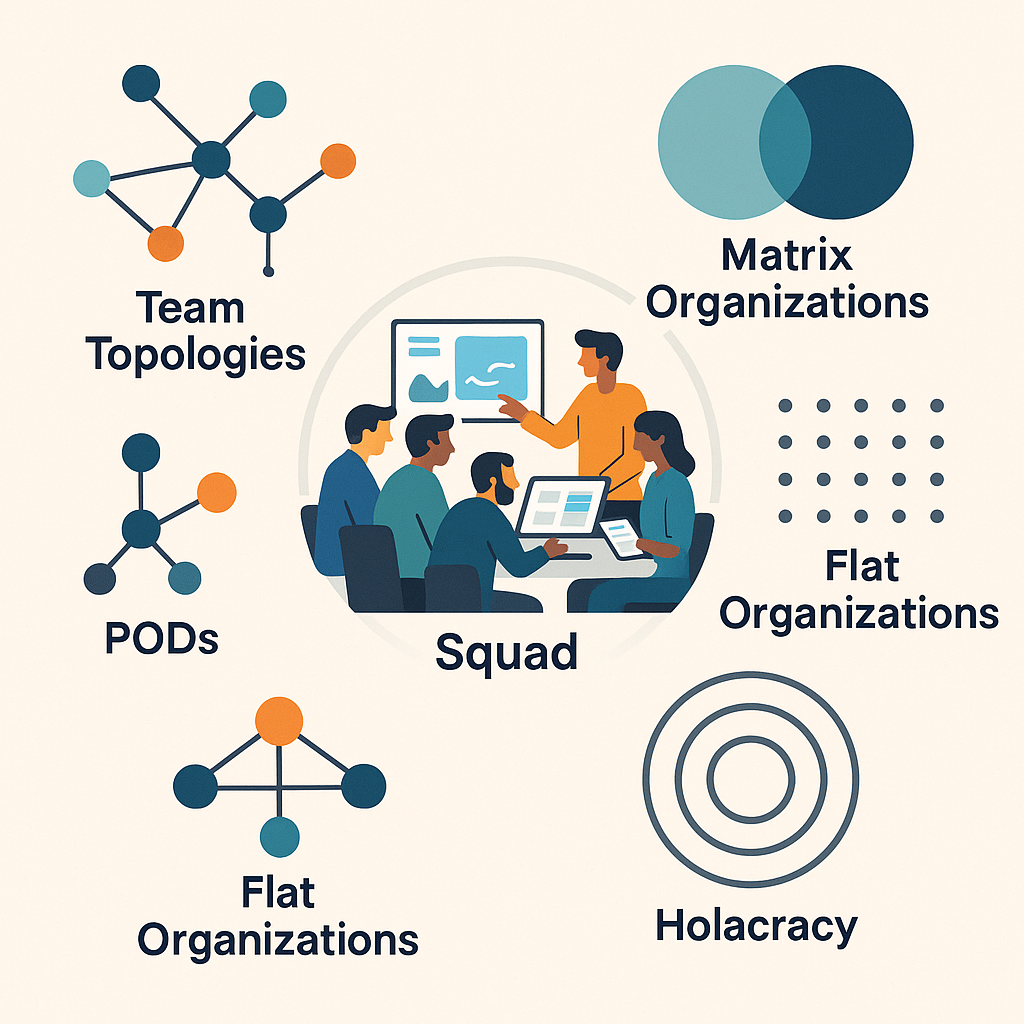
The squad model has long been the "golden child" of modern tech delivery. Known for its cross-functional, autonomous units that manage products end-to-end, it’s a favorite for organizations prioritizing fast-paced delivery and strong product ownership.
However, as tech organizations scale and diversify, the "one-size-fits-all" squad approach can start to show cracks. Depending on your company’s growth stage and complexity, an alternative structure might actually be the fuel your team needs.
Beyond the Squad: Alternative Organizational Models
While squads foster innovation, other frameworks provide specialized support for scaling or niche projects.
1. Team Topologies
Popularized by Matthew Skelton and Manuel Pais, this model focuses on the flow of work and reduces cognitive load by defining four specific team types:
- Stream-aligned teams: Focused on a continuous flow of work from a segment of the business domain.
- Enabling teams: Mentors who help other teams bridge knowledge gaps.
- Platform teams: Providing the internal tooling that allows stream-aligned teams to deliver faster.
- Complicated subsystem teams: Experts handling highly specialized math, physics, or technical layers.
2. Matrix Organizations
A blend of cross-functional agility and hierarchical expertise. Members report to both a functional lead (e.g., Head of Engineering) and a project lead. This allows for deep knowledge sharing across the org, though it requires crystal-clear roles to avoid the "two bosses" confusion.
3. PODs (Product Oriented Delivery)
Similar to squads but often more temporary or niche. PODs are small, specialized units that form around specific business targets or short-term goals, providing tailored agility without the long-term overhead of a permanent squad.
4. Flat and Networked Organizations
These structures minimize middle management to increase transparency and participation. They often resemble a "web" of teams connected by centralized protocols—ideal for early-stage startups needing rapid innovation.
5. Holacracy
A radical departure from traditional hierarchy, Holacracy distributes authority into self-governing circles. Each circle manages its own objectives, encouraging extreme adaptation and constant peer-to-peer learning.
Which Structure Fits Your Stage?
The "best" model is moving target. Recent industry data shows a clear divide based on company maturity:
| Company Size | Preferred Structure | Key Driver |
|---|---|---|
| Early-stage Startup | Flat / PODs / Networked | Speed and resource flexibility. |
| Midsize Tech | Squads / Team Topologies | Autonomy and ownership. |
| Large Enterprise | Matrix / Hybrid Topologies | Scalability and cross-functional alignment. |
As of 2025, squads remain the standard for mid-to-large organizations seeking a proven path to growth. However, smaller firms focused on "disruptive" innovation are increasingly thriving by using flatter, more fluid networked models.
🧠 Final Thoughts
Choosing a team structure isn't just a logistical decision—it’s a cultural one. A squad model won't work in a culture of micro-management, just as a matrix model will fail without excellent communication channels.
The goal isn't to pick the "coolest" model; it's to choose the one that minimizes friction and allows your engineers to do what they do best: build.