
In many software teams, there is a massive gap between what is written in a Jira ticket and what is actually tested in the code. This gap is where bugs hide and where code reviews become exhausting. By ensuring your BDD requirements and unit tests correspond line by line, you create a transparent, high-trust environment.
What is BDD?
Behavior-Driven Development (BDD) is a methodology designed to bridge the communication gap between business stakeholders and developers. It uses a structured language called Gherkin to describe how a feature should behave from the user's perspective.
The core of BDD is the scenario, which follows a specific flow: Given (the initial context), When (the action), and Then (the expected result). The primary goal of BDD is to define "what" the system does before the developer decides "how" to build it.
For example, a scenario for a login system might look like this:
- Given a user is on the login page
- When they enter valid credentials
- Then they should be redirected to the dashboard
The Problem: The Requirements Disconnect
Most developers read a ticket, understand the gist, and then write tests in a way that makes sense to them technically. The problem is that the structure of the test often loses the original business intent. When a lead reviews the code, they have to manually translate the technical test back into the business requirement to see if it actually works.
A lack of alignment between requirements and tests makes it impossible to verify completion at a glance. If the code review is difficult, the reviewer is more likely to miss logic errors. This leads to a breakdown in trust between the developer and the manager.
The Line-by-Line Alignment Rule
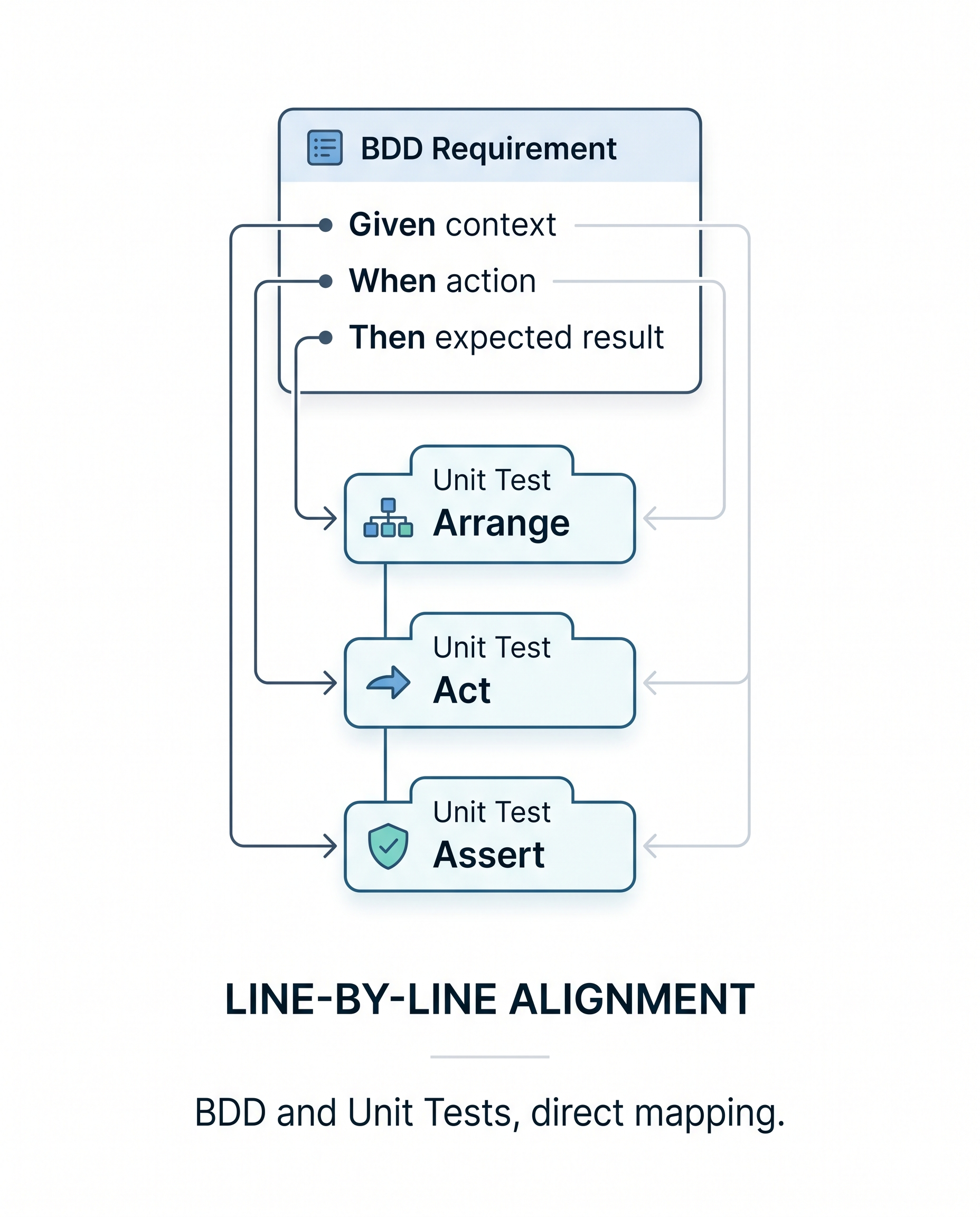
To solve this, I have introduced a specific rule: every BDD line in the ticket must have a corresponding line in the unit test. We use the Arrange, Act, and Assert (AAA) pattern to mirror the Given, When, and Then structure of the BDD scenario.
- Given maps to Arrange: This is where you set up your objects and data.
- When maps to Act: This is the specific method call or action being tested.
- Then maps to Assert: This is where you verify the outcome.
By mirroring the ticket structure in the test, you make the business logic the primary driver of the code. This ensures that every requirement is explicitly tested.
Practical Example in C#
Let's look at how this looks in a real-world C# environment. Imagine a requirement for a shopping cart discount.
The BDD Scenario in the Ticket
Ticket 123 - Scenario 1: Applying a seasonal discount
  Given the cart has a total of 100 euro
  And the seasonal discount is 10 percent
  When the discount is calculated
  Then the final total should be 90 euro
The Corresponding Unit Test
[Fact]
public void Calculate_ApplyingASeasonalDiscount_ReturnsReducedTotal()
{
    // Ticket 123 - Scenario 1: Applying a seasonal discount

    // Arrange
    // Given the cart has a total of 100 euro
    var cart = new ShoppingCart { Total = 100.00m };

    // And the seasonal discount is 10 percent
    var discountService = new DiscountService(rate: 0.10m);

    // Act
    // When the discount is calculated
    var result = discountService.Calculate(cart);

    // Assert
    // Then the final total should be 90 euro
    Assert.Equal(90.00m, result);
}
Self-Documenting Code through BDD Labels
Using comments to label the BDD steps inside the test makes the code self-documenting. By explicitly marking sections as Given, When, and Then, you create a direct map to the business logic. Even a product manager could look at this code and understand that the requirement has been met.
When a developer uses these labels, they are not just writing code, they are documenting a behavior. This practice forces a clear separation between setup, execution, and verification.
Actionable Takeaway: Start every unit test by writing out the BDD scenario as comments before writing a single line of functional code.
Improving the TDD Loop with Living Specifications
This approach makes Test-Driven Development (TDD) much more natural and intuitive for the team. If a ticket is rejected or a requirement changes, you do not start by changing the production code. You start by changing the specific BDD line in the test that now fails.
Aligning tests with requirements allows you to treat the unit test as a living specification. This creates a feedback loop where the code verifies the requirements in real time. If a scenario is wrongly written at the start, it becomes obvious during the Arrange phase of the test. You can catch requirement errors before the feature is even finished.
Actionable Takeaway: When a requirement shifts, update the unit test first to reflect the new BDD line and watch it fail before applying the fix.
Strategic Benefits of Aligning BDD Requirements and Unit Tests
As an engineering leader, your time is your most valuable asset. When your team follows this rule, code reviews become significantly faster. You no longer need to keep the ticket and the code in two different windows to check for parity.
Clear alignment between BDD requirements and unit tests builds immediate trust in the developer's output. You can see that every Given and Then has been accounted for without digging through complex logic. This discipline leads to higher quality releases and a more professional engineering culture.
Actionable Takeaway: Use the line by line alignment as a checklist during pull requests to verify that all business cases are covered.
Maintaining Focus on Business Logic
Unit tests must be strictly focused on the BDD requirements provided in the ticket. If you need to include setup code or assertions that are not explicitly part of the business scenario, you must label them clearly. Every Arrange or Assert not related to a line in the BDD should be marked as "Additional" in the comments. Similarly, if an Act step involves technical methods not mentioned in the BDD, it should be specified as such. This keeps the primary business logic visible and prevents technical noise from obscuring the requirements.
Summary of Recommendations
To implement this successfully, you should focus on a few key cultural shifts within your team:
- Enforce the rule that unit tests must mirror BDD scenarios line by line.
- Use comments to make the connection explicit in the code.
- Reject PRs where the test logic does not clearly represent the business requirements.
- Use alignment to simplify the debugging process and improve TDD efficiency.
Mastering the relationship between BDD requirements and unit tests is the fastest way to improve your team's reliability. It turns testing from a chore into a powerful tool for clarity and delivery.