

Mind Refactor is a publication about programming, Agile, management, leadership, and career advice, where I share insights and experiences from the tech world. I write about what I see while building software and working with teams, including the choices that help people learn, work better together, and grow in their careers.

The more I use AI and talk with other managers, the more I see a gap between what these tools could help us do and what is actually happening in some teams.

We are spending money on powerful tools that allow us to produce code, documents, and plans in minutes, but in the situations I am seeing, the improvement in completed work is often small. Sometimes a ticket even takes longer than before, and when I look at how some junior developers are using these tools, I also worry about how much they are learning along the way.

I don't really like this direction, although I think we are still in time to adjust it. I have seen people who already work well become even better with AI, which gives me confidence that there is a lot of potential here if we pay attention to how we use it.

A pull request is one place where the problem becomes visible: a developer generates a lot of code in a few minutes and sends it for review after barely reading it. Another developer then spends hours understanding the changes, finding mistakes, and explaining why part of the solution does not fit the project. The first person may have saved time, but once we include all that extra review work, the team may have lost it.
Read full article →

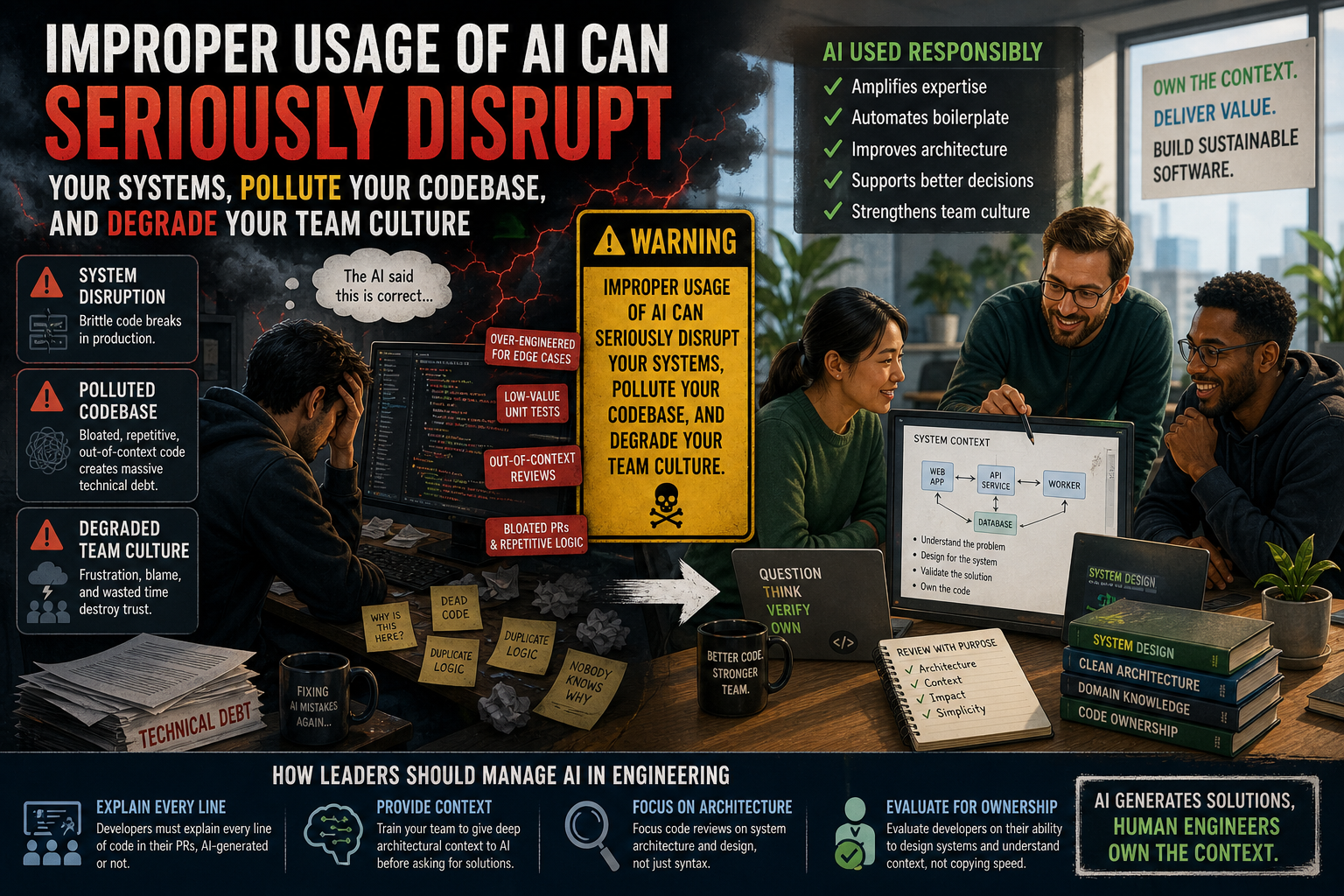
All the world is adopting AI tools like ChatGPT, Gemini, and Claude expecting a massive boost in developer productivity. The reality is much more complicated. AI is highly effective, but it exponentially increases the underlying skills of the person using it. If an engineer is experienced and understands the system, AI makes them excellent. But if a developer lacks foundational knowledge, improper usage of AI risks making them significantly worse. Instead of writing better software, teams are generating massive amounts of technical debt at unprecedented speeds.

AI does not inherently elevate people, code, or infrastructure. It simply amplifies what is already there. Good engineers use AI to automate boilerplate, brainstorm architecture, and scaffold complex ideas. Inexperienced engineers often use conversational AI as a shortcut to write logic they do not actually understand or actually need.

An AI assistant cannot replace the architectural context that lives inside an experienced developer. This creates a dangerous scenario. An inexperienced or distracted developer pastes a prompt into a chatbot and produces code that looks syntactically correct but is fundamentally flawed for the specific use case. The AI reveals their technical debt and lack of system knowledge rather than hiding it.

One of the biggest risks of AI generation is overconfidence. Developers are becoming overconfident because the AI tells them they are right. They trust the generated output implicitly and stop questioning the logic.

Read full article →

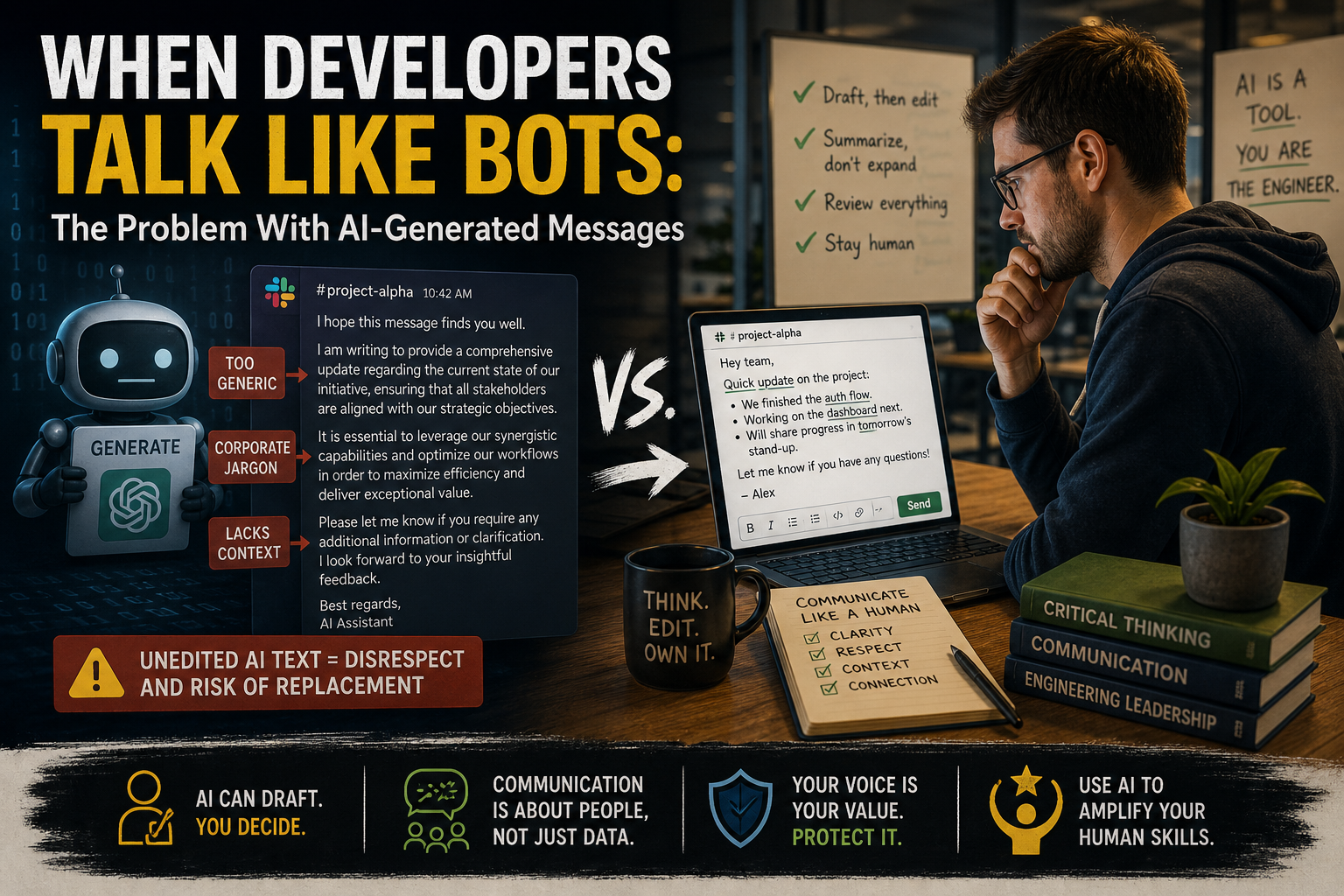
You receive a message from a colleague on Slack. Instead of their usual quick reply, you get a four-paragraph essay filled with corporate jargon and strange vocabulary. They did not write it. They used an AI to answer you. Copy-pasting unedited AI-generated messages is becoming a common and frustrating habit among tech professionals. This practice damages trust and raises a serious question about the future of our industry. If a developer starts communicating entirely through raw AI output, are they proving that their job can be fully automated?

Communication is a core skill for any successful engineer or manager. When you send someone a long block of text generated by an AI without reviewing it, you are making a clear statement. You are telling the recipient that their time is worth less than yours. Sending unedited AI text is a fundamental lack of respect for the person reading it. You force your peers to parse through generic fluff to find the actual meaning. This friction slows down teams and destroys interpersonal relationships.

People in tech are openly worried about AI taking their jobs. Yet, some of those same people are voluntarily turning themselves into meat-based API endpoints. If your daily output consists of blindly forwarding ChatGPT responses, you are removing your unique human value from the equation. If you choose to operate like a mindless proxy for a language model, you are practically begging to be replaced by one. We still have the power to control AI and make our own decisions. Surrendering that control out of laziness is a dangerous game to play.

Many developers misunderstand the true potential of AI tools. They treat them as a replacement for thinking rather than a partner for drafting. This leads to several predictable errors.

Read full article →