
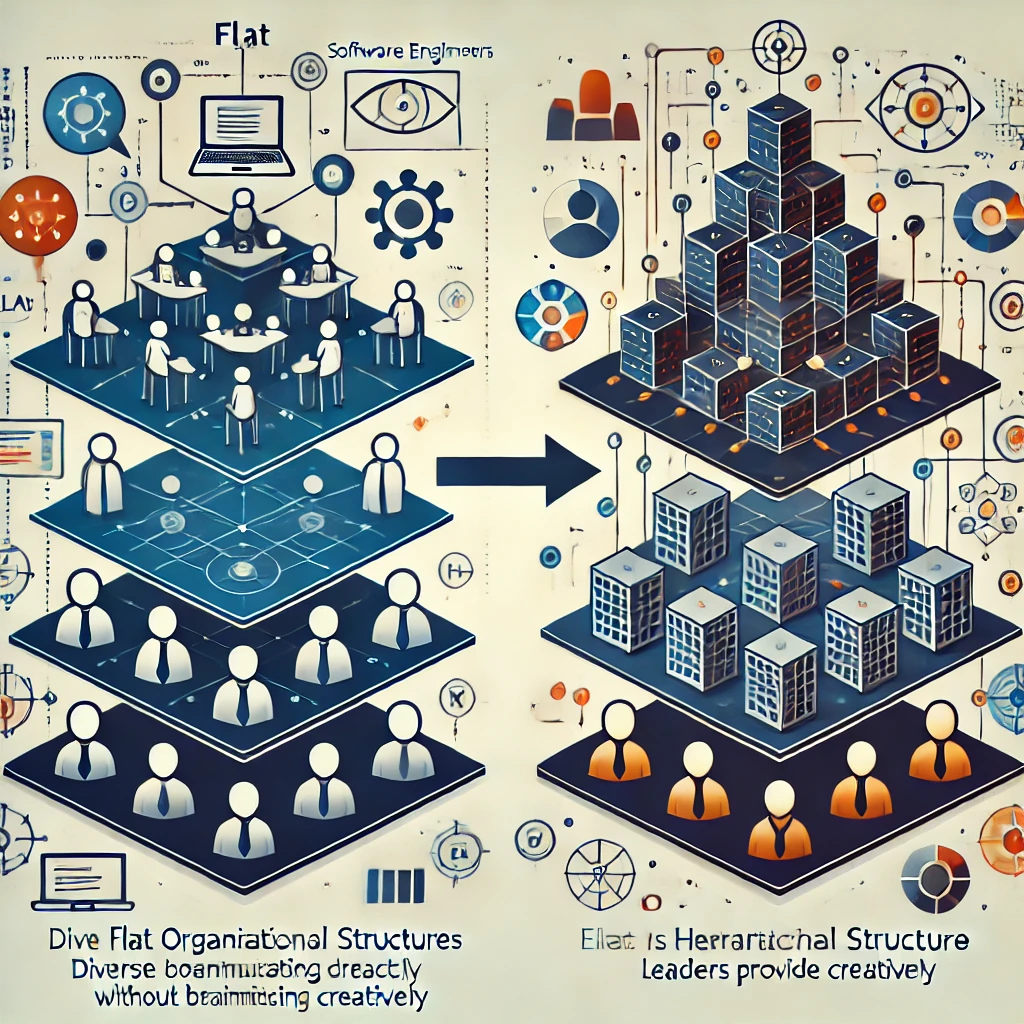
I’ve witnessed the ongoing debate between flat and hierarchical team structures throughout my career. In the fast-paced world of software engineering, both models have distinct merits, but choosing the right one is often a matter of balancing speed with stability.
Flat Structures: Empowering Creativity and Innovation
🚀 Flat organizational structures minimize management layers, fostering direct communication and collaboration. In engineering environments, this approach often yields impressive results:
- Faster Decision-Making: Engineers can act quickly on technical choices without navigating a "bureaucratic maze" of approvals.
- Enhanced Creativity: With fewer structural barriers, unconventional ideas flow freely, sparking the next wave of innovation.
- Increased Responsibility: When there is no "boss" hovering over every commit, team members feel a deeper sense of accountability for the final outcome.
The Challenge: Flat structures aren't a silver bullet. As teams grow, coordination becomes complex. Without clear leadership, career progression paths can become muddy, and decision-making can stall in "consensus paralysis." This model also requires high seniority; engineers must deeply understand the system to make autonomous choices effectively.
Hierarchical Structures: Providing Clarity and Direction
🏗️ Traditional hierarchies offer clear reporting lines and defined roles. In larger software organizations, this structure provides a necessary backbone:
- Structured Decision-Making: Critical architectural choices involve experienced leaders, reducing the risk of technical debt.
- Clear Career Paths: Engineers have a visible trajectory (Junior → Senior → Staff → Principal) for advancement.
- Efficient Scaling: Hierarchies are built to maintain order and consistency as a company grows from 50 to 5,000 employees.
The Challenge: The primary downside is the potential for "silos." Hierarchies can slow down communication and stifle innovation if an engineer's great idea has to travel through four layers of management to be heard.
Finding the Middle Ground: The Hybrid Model
🔄 In my experience, the most effective approach is a hybrid model. By blending both philosophies, we can create an environment that captures the best of both worlds:
- Lean Management: Maintain a small group of leaders for overall direction, strategy, and high-level accountability.
- Cross-Functional Squads: Implement flat, autonomous teams (similar to the "Spotify Model") for specific projects.
- Open Channels: Encourage communication across all levels, ensuring that a Junior Dev can still easily ping a VP of Engineering with a technical question.
- Balanced Autonomy: Establish processes where teams have autonomy over how they build, while leadership provides the oversight on what and why.
The "best" structure depends entirely on your team’s size, goals, and current culture. Regardless of the formal lines on a chart, the goal remains the same: fostering an environment where engineers feel empowered, communication flows freely, and innovation thrives.
Further Reading: Check out this deep dive on Flat Hierarchies to see how different industries are adapting.