
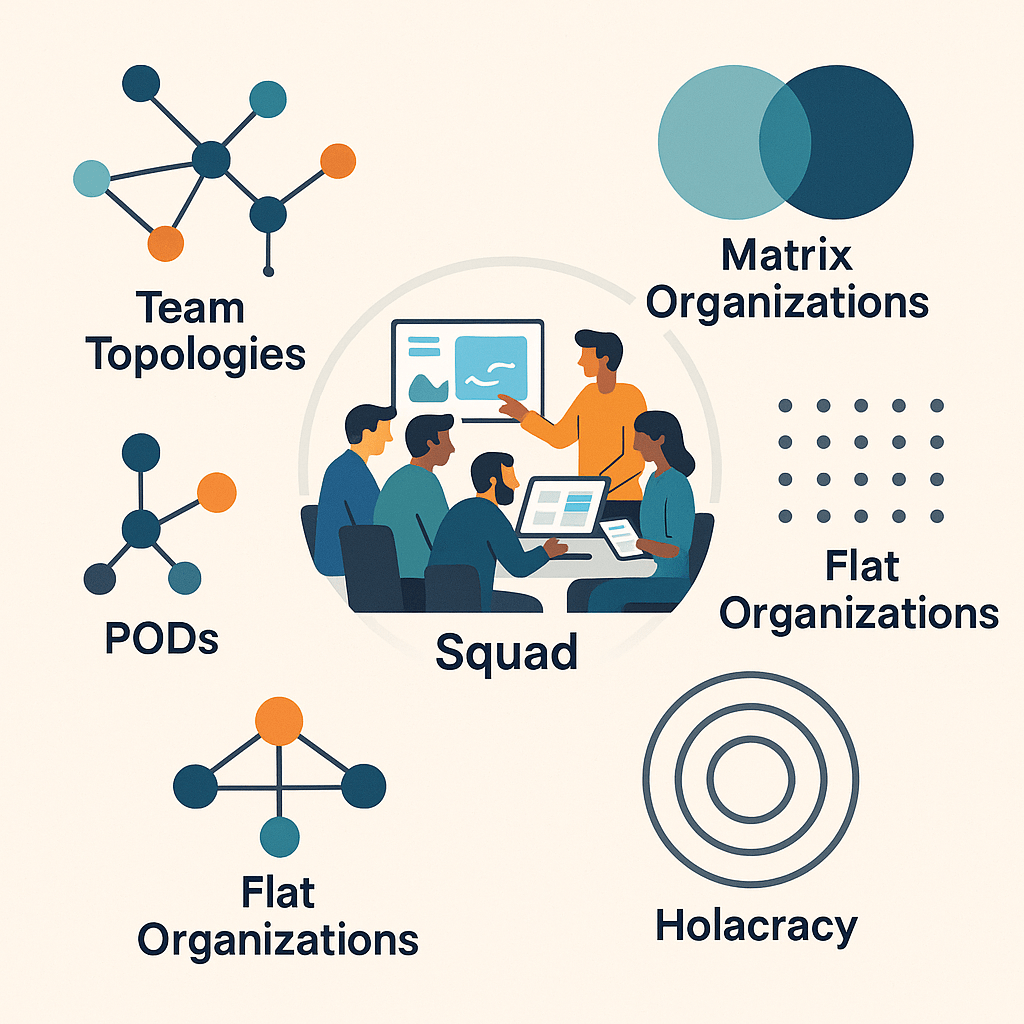
The squad model, known for its cross-functional, autonomous units managing products end-to-end, is the favorite for fast-paced delivery and product ownership. Squads are structured to foster agility, innovation, and a strong sense of ownership among team members, which is why many modern organizations use them as a blueprint for effective software development teams.
However, squads are not the only option. As tech organizations scale and diversify, alternative structures may offer a better fit:
- Team Topologies introduce a mix of stream-aligned teams (business focus), enabling teams (mentoring function), platform teams (shared tooling), and complicated subsystem teams (specialized knowledge). This model helps organizations flexibly scale by clarifying responsibilities and improving the flow of work.
- Matrix Organizations blend cross-functional agility with hierarchical expertise. Team members report to both functional and project leads, enabling knowledge sharing and optimal resource use, though this structure demands clear roles to avoid confusion.
- PODs are small, specialized teams similar to squads but may form around temporary needs or niche projects, providing tailored agility for specific business targets.
- Flat and Networked Organizations flatten hierarchies to fuel participation and transparency or create webs of teams connected by centralized protocols, ideal for companies needing fast innovation without excessive structure.
- Holacracy distributes authority into self-governing circles. Each circle manages its objectives, encouraging rapid adaptation and ongoing learning.
Ultimately, the right approach depends on company goals, growth stage, and culture. Squads drive velocity and ownership, while alternatives like team topologies or matrix models may suit complex scaling needs or innovation-driven strategies.
Recent industry data highlights that squads are especially common in larger tech companies and enterprises, where cross-functional alignment and scalability are critical for growth. In contrast, smaller startups or early-stage businesses typically favor flatter team structures, PODs, or cross-functional agile groups to maintain agility and resource flexibility. As of 2025, squads are still a broadly adopted, proven strategy for midsize and large organizations, while alternatives thrive among smaller firms focused on rapid innovation.


Leave a comment