
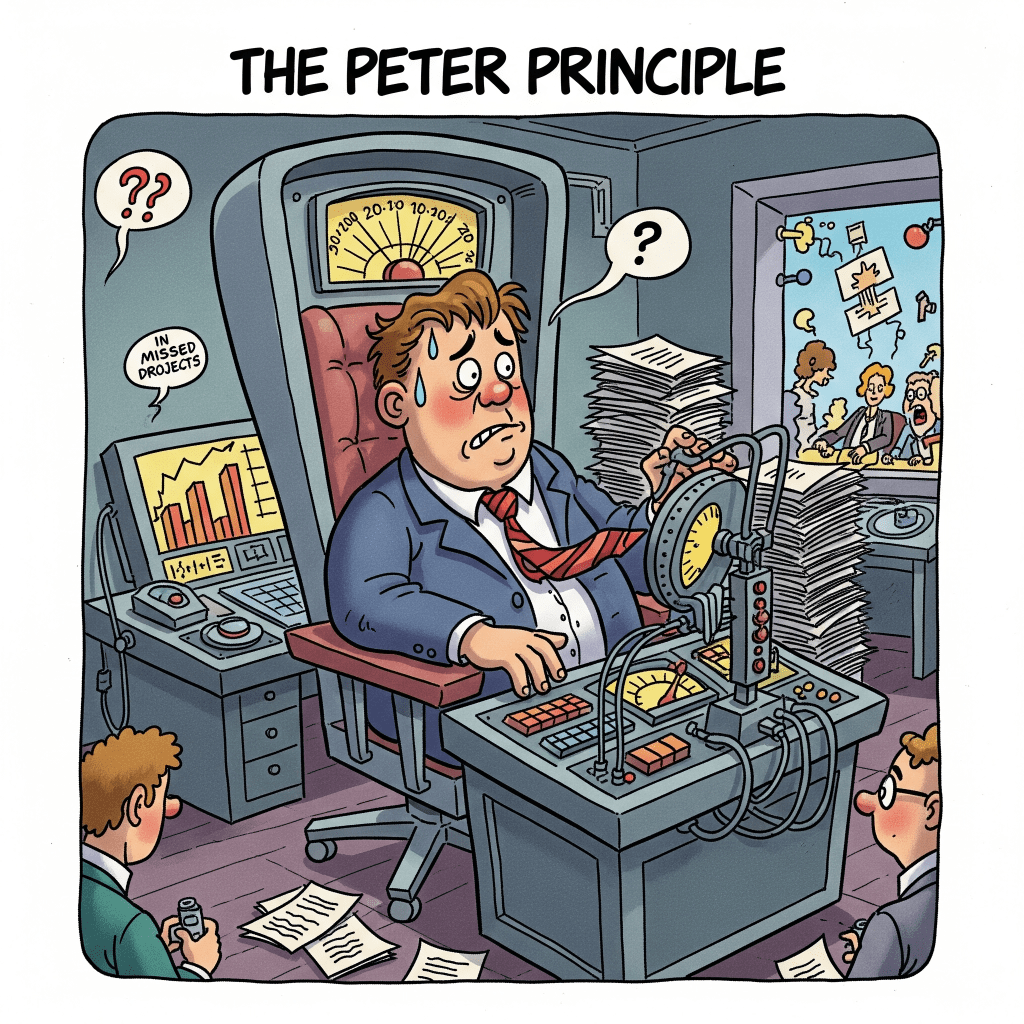
“In a hierarchy, every employee tends to rise to their level of incompetence.”
The Peter Principle is a management concept first introduced in 1969 by Laurence J. Peter and Raymond Hull. It states that in hierarchical organizations, employees are promoted based on their success in previous roles until they reach a level at which they are no longer competent, their “level of incompetence.” This happens because the skills that make someone excel in one job don’t always overlap with those needed for their new, higher role, leading to decreased performance after promotion
Although the book was written as satire, it resonated as a serious critique of organizational promotion practices. Over time, research and real-world observation have provided evidence that supports the existence of the effect
What does that mean?
📈 People are promoted based on how well they perform in their current role.
🔁 Eventually, they’re moved into a new position that demands a completely different skill set.
⚠️ And when they no longer perform well… they stay stuck there! Often indefinitely.
Take a great software developer. He is great as an individual contributor, so he’s promoted to team lead. But leadership is about people management, planning, communication, and not just code. If he struggles, he won’t be moved to a different role… he will be just quietly trapped in a role that no longer fits him. Something similar tends to happen in more senior roles.
🛠 How can it be avoided?
✅ Promote based on potential for the next role, not just success in the current one
Don’t just reward current performance — evaluate the skills required in the next role (e.g. emotional intelligence, delegation, coaching). Use role-specific competencies and structured interviews.
✅ Provide leadership training before and after the transition
Offer training, mentoring, or job shadowing before someone steps into a new role. Let them “try before they fly.”
✅ Normalize stepping back
Make it culturally safe to step out of a misaligned role without stigma. Sometimes, people realize it’s not for them — and that’s OK.
✅ 360° feedback loops
Use structured feedback from peers, reports, and managers to regularly evaluate whether someone is thriving or just surviving in their new role.
A satirical piece from Peter’s original book?
“Work is accomplished by those employees who have not yet reached their level of incompetence.”
💥 Ouch.
Read an article about it on Forbes: https://www.forbes.com/sites/roddwagner/2018/04/10/new-evidence-the-peter-principle-is-real-and-what-to-do-about-it/


Leave a comment