If you’re new to programming, you might be curious about the easiest or hardest languages to learn. While many beginners start with Python for its simplicity, Malbolge is on the opposite end of the spectrum. This esoteric programming language was intentionally designed to be nearly impossible to understand and use, earning it the title of “most complicated programming language.”
🛠️ Why Malbolge is the Hardest
1. Complex Syntax: The syntax is cryptic and lacks logical structure, resembling random characters rather than readable commands (https://www.lokajittikayatray.com/post/5-most-difficult-programming-languages-in-the-world)
2. Lack of Community: With minimal documentation and almost no active developer community, learning resources are scarce.
3. Historical Challenge: It took two years after Malbolge’s creation in 1998 for the first program to be successfully written in it, and many believe that Ben Olmstead never developed a single program in this language (https://invozone.com/blog/most-hardest-programming-languages-to-learn/).
Curious to See Malbolge in Action? 🤔
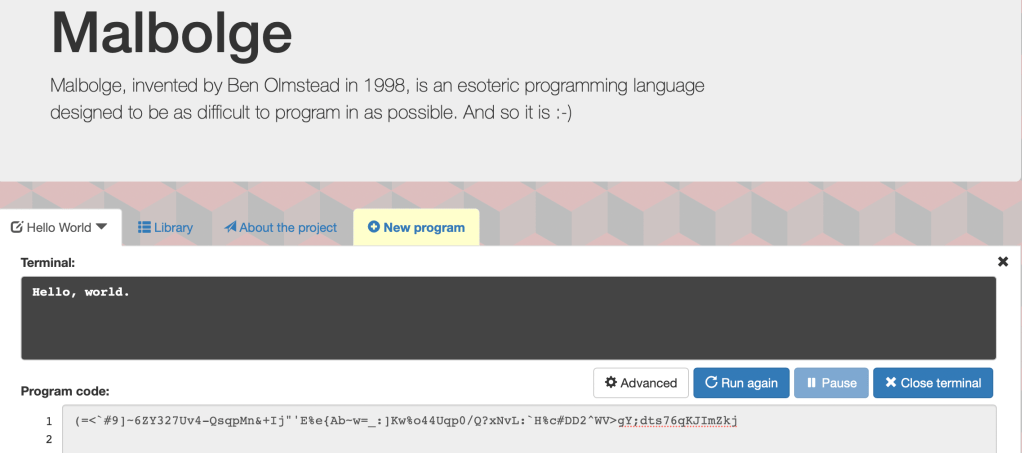
Here’s how you would print “Hello World” in Malbolge:
(=<`#9]~6ZY32Vx/4Rs+0No-&Jk)”Fh}|Bcy?`=*z]Kw%oG4UUS0/@-ejc(:’8dc
Yes, that’s actual code! It looks more like gibberish than a program, doesn’t it? You can try it here: https://malbolge.doleczek.pl/
🧩 Other Notably Difficult Languages
• Brainfuck: Minimalistic yet unintuitive, with only eight commands that make even simple tasks verbose.
• Haskell: A functional programming language with abstract concepts and heavy recursion that demand a steep learning curve.
Why Does Malbolge Exist?
Malbolge isn’t meant for practical use. It’s more of a conceptual or artistic experiment. Invented by Ben Olmstead in 1998, it was named after the “eighth circle of hell” in Dante’s Inferno, reflecting its nightmarish complexity (https://en.wikipedia.org/wiki/Malbolge).
Despite its challenges, Malbolge has fascinated programmers who enjoy pushing the boundaries of what’s possible in coding. However, if you’re just starting out, stick with beginner-friendly languages like Python!
Discover more from Mind Refactor
Subscribe to get the latest posts sent to your email.
Mind Refactor

Exploring how technology reshapes our world 🌍 | Insights on Programming, Startups, Management & Leadership 🚀
Curious how technology is reshaping our world? 🚀
Dive into insights on Programming, Startups, Management & Leadership at Mind Refactor. Leave your email here.

Leave a comment